Executing a workplace furniture setup project is one of the most operationally complex responsibilities a Facility Manager or Workplace Manager can face. Unlike design or architecture decisions made earlier in the process, furniture implementation demands precise coordination across procurement, logistics, installation, and post-installation validation, all while keeping disruption to the business at an absolute minimum.
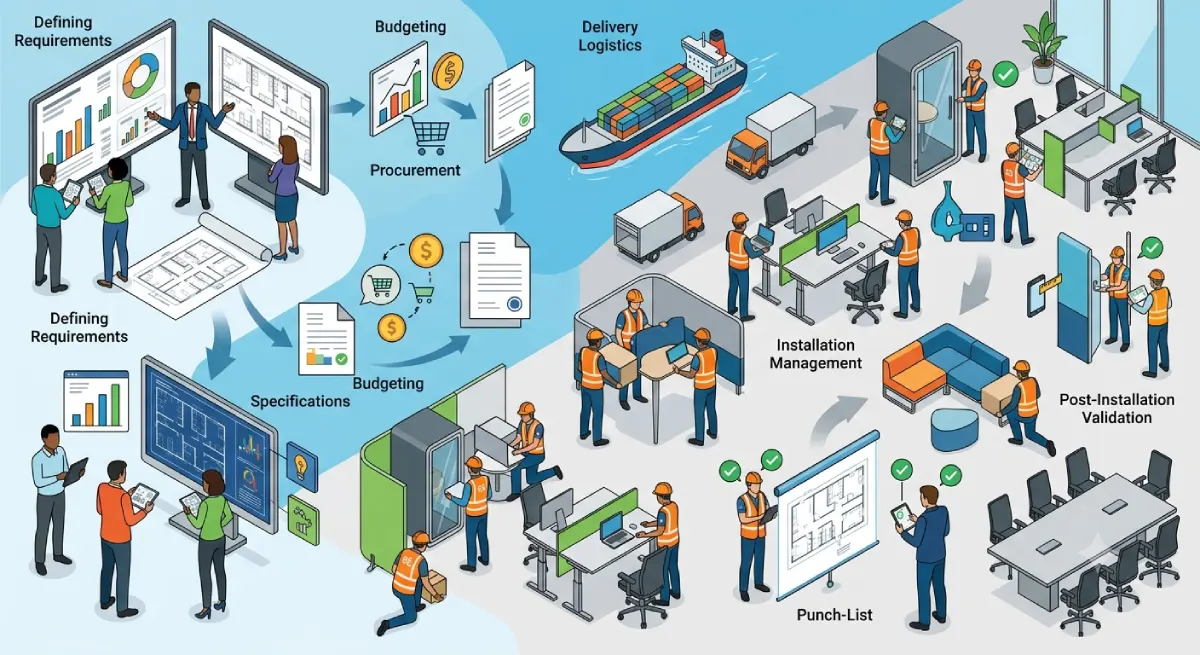
This guide is written specifically for Facility Managers and Workplace Managers at companies with 50 to 300 employees who are executing hybrid office furniture projects. It covers the full furniture setup lifecycle: from defining requirements and creating specifications, through budgeting and procurement, to delivery logistics, installation management, and final validation. If you are responsible for getting furniture from purchase order to fully operational workspace, this guide is for you.
If you are looking for guidance on how to define furniture standards before execution, see our companion guide on hybrid office furniture selection strategy.
Understanding the Hybrid Office Furniture Setup Challenge
Hybrid offices introduce unique complexity into furniture setup projects. Unlike traditional fixed-seat environments where every employee has an assigned desk, hybrid workplaces require furniture systems that support multiple use modes: hot desking, collaboration zones, focus areas, and meeting spaces , often all within the same floorplate.
Facility Managers must plan for furniture that is flexible, durable, and compatible with activity-based working models. The setup challenge is not just about placing desks , it is about deploying systems that align with how people actually use the space.
Key factors that distinguish hybrid furniture setup from traditional office installations include:
- Higher furniture diversity: Multiple furniture typologies must be specified, procured, and installed in a coordinated sequence.
- Phased occupancy: Hybrid offices often open in stages, requiring furniture to be installed and validated in multiple phases.
- Flexibility requirements: Furniture must be reconfigurable as hybrid work patterns evolve over time.
- Technology integration: Workstations, collaboration furniture, and meeting rooms must seamlessly accommodate power, data, and AV integration points.
BHouse Solution: Operational Setup Excellence
BHouse advises organizations across Florida on managing the complete operational lifecycle of hybrid workplace deployments. Our team coordinates logistics, technology integration, and phased installations to ensure minimum business disruption and complete technical validation.
Phase 1: Defining Requirements
Every successful furniture setup project begins with a structured requirements definition phase. This is not about selecting aesthetics , it is about identifying operational needs that will drive every procurement and installation decision downstream.
Headcount and Occupancy Analysis
Before a single specification is written, Facility Managers must establish a clear picture of how many people will use the space, how frequently, and in what configurations. For hybrid environments, this means understanding:
- Peak concurrent occupancy: The maximum number of employees expected on-site simultaneously.
- Average daily occupancy: The typical attendance level that will drive standard workstation demand.
- Role-based space needs: Which employee groups require dedicated workstations versus shared hot-desking environments.
- Collaboration intensity: How frequently teams need conference rooms, huddle spaces, or open collaboration zones.
Activity-Based Working Zones
For hybrid environments following activity-based working models, requirements must be defined at the zone level, not just the individual workstation level. Typical zones requiring separate furniture specifications include: individual focus workstations, collaborative team areas, formal conference rooms, informal meeting and lounge zones, phone/video call booths, and reception or lobby areas.
Technical and Operational Requirements
Requirements must also capture technical constraints: power access points at workstations, cable management systems, data port locations, monitor arm compatibility, ergonomic adjustability standards, and storage requirements for unassigned seating environments.
| Requirements Category |
Key Questions to Answer |
Output Document |
| Headcount & Occupancy |
Peak and average occupancy by zone; desk-sharing ratios |
Occupancy Analysis Report |
| Zone Programming |
What activities occur in each zone; how many people per zone |
Zone Programming Schedule |
| Technical Standards |
Power, data, ergonomic, and AV requirements by zone |
Technical Specification Sheet |
| Flexibility Needs |
Which furniture must be reconfigurable; anticipated change timeline |
Flexibility Requirements Matrix |
| Brand & Durability |
Aesthetic standards; commercial-grade durability requirements |
Product Selection Criteria |
BHouse Solution: Workplace Requirements Programming
BHouse helps organizations translate complex headcount data into actionable furniture requirements. Our team assists Facility Managers in generating all key documentation, from Technical Specification Sheets to Occupancy Analysis Reports, ensuring your execution plan is foolproof.
Phase 2: Creating Furniture Specifications
Once requirements are defined, Facility Managers must translate them into detailed furniture specifications. Specifications serve as the foundation for vendor quoting, procurement contracts, and installation verification , they must be precise. A complete furniture specification package includes:
- Product specifications: Manufacturer, model number, finish, dimensions, and configuration for every furniture item.
- Quantity schedules: Exact quantities per item, per zone, per floor.
- Installation drawings: Furniture layout plans showing exact placement and orientation.
- Technical datasheets: Manufacturer documentation confirming compliance with commercial-grade standards.
- Lead time requirements: Delivery timelines required for each product category.
One of the most common execution failures in furniture setup projects is under-specified procurement packages. Vague specifications lead to incorrect product ordering, substitution disputes with vendors, and costly re-deliveries. Specifications should be reviewed and signed off by all stakeholders before procurement begins.
BHouse Solution: Specification Development
BHouse manages the complete furniture specification process for hybrid office projects across Florida. Our project managers translate occupancy analysis and zone requirements into fully documented specification packages , including product schedules, installation drawings, and technical datasheets , reducing specification errors and ensuring procurement proceeds without delays.
Phase 3: Budgeting for Furniture Setup Projects
Accurate budgeting is one of the most challenging aspects of furniture setup execution. Facility Managers must account not only for product costs but for all project delivery costs , many of which are systematically underestimated.
Total Project Cost Components
A complete furniture setup budget must include:
- Product costs: Furniture purchase price including all configurations and finishes.
- Freight and delivery: Shipping from manufacturer or dealer warehouse to project site.
- Installation labor: Professional installation including assembly, placement, and debris removal.
- Project management: Coordination of procurement, delivery scheduling, and installation supervision.
- Contingency: Typically 10 to 15 percent for specification changes, damaged goods, and lead time extensions.
- Punch-list resolution: Labor and material costs for correcting post-installation deficiencies.
Budget Planning Timeline
For projects involving 50 to 300 workstations, Facility Managers should build budget estimates no later than 90 days before the target installation date. Lead times on commercial-grade furniture ,particularly height-adjustable desks and ergonomic seating , frequently run 8 to 14 weeks. Late budget approval forces expedited shipping, which can add 15 to 25 percent to total product costs.
| Budget Category |
Typical % of Total Project Cost |
Risk Level |
| Furniture Products |
60 – 70% |
Low (fixed once specified) |
| Freight & Delivery |
5 – 10% |
Medium (varies by location) |
| Installation Labor |
10 – 15% |
Medium (scope can expand) |
| Project Management |
3 – 7% |
Low |
| Contingency |
10 – 15% |
High (critical to include) |
Phase 4: Procurement Coordination
Procurement coordination is where furniture projects most frequently encounter execution risk. Even well-specified projects can fail at procurement if vendor management, order tracking, and lead time monitoring are not actively managed.
Vendor Selection and Order Placement
For hybrid office furniture projects, Facility Managers should work with authorized dealers who have direct relationships with commercial furniture manufacturers. Authorized dealers provide:
- Access to full product catalogs with commercial-grade specifications.
- Accurate lead time information at the time of order placement.
- Order acknowledgment and production tracking through manufacturer systems.
- Warranty administration and post-delivery claims support.
Order Tracking and Lead Time Management
Once purchase orders are placed, Facility Managers must implement an active order tracking process. Key tracking milestones include: order acknowledgment confirmation, production start date, estimated ship date, warehouse receipt confirmation, and scheduled delivery date to site.
For large projects with multiple product lines, a tracking matrix with weekly status updates is essential. Furniture arriving out of sequence can block installation and create costly rescheduling.
BHouse Solution: Procurement Management
BHouse manages the full procurement process for hybrid office furniture projects across Florida , from vendor selection and order placement through lead time tracking and delivery coordination. Our project managers maintain active order status visibility and proactively resolve supply chain issues before they affect installation schedules.
Phase 5: Delivery Logistics
Furniture delivery logistics for commercial office projects require detailed pre-planning. Unlike residential deliveries, commercial installations involve coordinating building access, freight elevator scheduling, staging area setup, and just-in-time sequencing of multiple product deliveries.
Site Readiness Assessment
Before any furniture delivery is scheduled, the installation site must be verified as ready to receive furniture. Site readiness criteria include:
- Flooring installation complete and protected.
- Electrical and data rough-in complete at all workstation locations.
- HVAC operational in the installation zone.
- Building access confirmed for delivery vehicles and freight elevators.
- Staging area identified and cleared for furniture assembly.
Delivery Sequencing
Furniture must be delivered in installation sequence. Delivering panel systems, workstation components, or storage units in the wrong order requires costly repositioning or creates conditions where installers cannot proceed. Facility Managers should work with their dealer or project manager to develop a delivery sequence plan aligned with the installation schedule.
Phase 6: Installation Management
Professional installation management is critical to project quality and schedule compliance. Furniture installation for a 50 to 300 person hybrid office is a multi-day or multi-week project requiring active supervision.
Installation Supervision Requirements
Installation supervision responsibilities include:
- Daily check-ins with installation crew leads to verify schedule compliance.
- Verification of furniture placement against installation drawings before items are fully assembled.
- Identification and documentation of damaged or incorrect product at point of installation.
- Coordination of technology integration points , ensuring furniture placement aligns with data and power locations.
- Management of access and safety protocols for concurrent trades working in the space.
Managing Installation Changes
Field conditions frequently require minor installation adjustments , power outlet locations that differ from plans, structural elements that block furniture placement, or last-minute user requirement changes. Facility Managers must be empowered to approve minor field adjustments while escalating material scope changes through a formal change order process.
BHouse Solution: Installation Management
BHouse provides on-site installation management for hybrid office furniture projects throughout Florida. Our installation supervisors manage crew coordination, placement verification, damage documentation, and field adjustments, ensuring installations are completed on schedule and to specification without requiring Facility Managers to dedicate in-house resources to full-time site supervision.
Phase 7: Post-Installation Validation
Post-installation validation is the final phase of the furniture setup lifecycle and one of the most frequently skipped a mistake that leads to operational issues and delayed full occupancy.
Punch-List Development and Resolution
Within 24 to 48 hours of installation completion, Facility Managers should conduct a formal punch-list walkthrough. The punch list documents:
- Items delivered with damage or defects requiring replacement.
- Furniture placed incorrectly relative to installation drawings.
- Missing components : Shelving, cable grommets, monitor arms, task lighting.
- Ergonomic adjustment verification ,confirming height-adjustable desks function within full range.
- Storage and locking system functionality.
User Orientation and Ergonomic Training
For hybrid workplaces with shared furniture and hot desking systems, end-user orientation is a critical post-installation activity. Employees must understand how to adjust ergonomic seating, raise and lower height-adjustable desks, use storage systems, and reserve workstations if desk booking software is deployed.
Facilities teams that skip user orientation frequently face a high volume of ergonomic complaints and adjustment support requests in the first 30 days of occupancy.
| Validation Activity |
Responsible Party |
Timeline |
| Punch-list walkthrough |
Facility Manager + Installer |
Within 48 hours of installation |
| Damage claims filing |
Dealer / Project Manager |
Within 5 business days |
| Missing component delivery |
Dealer |
Within 10 business days |
| User orientation sessions |
Facility Manager + HR |
First week of occupancy |
| 30-day operational review |
Facility Manager |
30 days post-occupancy |
Frequently Asked Questions
- How early should a Facility Manager begin planning a hybrid office furniture setup project?
- For projects involving 50 or more workstations, planning should begin at least 16 to 20 weeks before the target occupancy date. Commercial furniture lead times typically run 8 to 14 weeks, and requirements definition, specification development, and procurement coordination require an additional 4 to 6 weeks before orders can be placed.
- What is the most common cause of furniture installation delays?
- The most common cause is product arriving out of sequence or with incomplete shipments due to insufficient order tracking during the procurement phase. Active order management , tracking each line item from purchase order through warehouse receipt , is essential to keeping installation schedules on track.
- How should Facility Managers handle furniture damage discovered during installation?
- Damage discovered during installation should be documented immediately with photographs, tagged on the punch list, and reported to the dealer within 24 to 48 hours. Most commercial furniture warranties require timely damage reporting , delayed notification can void claims. Installers should set damaged items aside and continue with undamaged product to avoid schedule delays.
- What furniture is typically required for a hybrid office hot desking environment?
- A hybrid hot desking environment typically requires height-adjustable desks to accommodate multiple users, ergonomic seating with easy adjustability, cable management systems at each station, personal storage solutions such as mobile pedestals or lockers, and monitor arms or laptop risers. Meeting and collaboration zones require separate furniture specifications based on their specific use requirements.
- How do Facility Managers validate that ergonomic furniture is installed and functioning correctly?
- Post-installation validation should include functional testing of all height-adjustable desks across their full range of motion, verification that ergonomic chairs include all specified components and adjustment mechanisms, and confirmation that monitor arms are installed at the correct height and reach for seated and standing positions. User orientation should reinforce proper adjustment techniques.
- Should Facility Managers use a general contractor or a specialized furniture dealer for hybrid office installations?
- For furniture-only projects, working with an authorized commercial furniture dealer with dedicated installation capability is strongly preferred. Specialized dealers have product knowledge, manufacturer relationships, and installation expertise that general contractors typically lack. For large projects involving multiple trades, a furniture dealer operating as the furniture-specific subcontractor under a general contractor structure is often the most effective approach.
Ready to Execute Your Hybrid Office Furniture Project?
BHouse manages end-to-end furniture setup for hybrid offices across Florida , from requirements definition and specification development through procurement, delivery, installation management, and post-installation validation.
Contact BHouse today for a complimentary furniture setup consultation and project assessment. Our team will evaluate your project requirements, identify procurement and installation risks, and deliver a project roadmap that keeps your furniture implementation on schedule and on budget.
Visit www.bhouse.com or call our Miami office to schedule your consultation.