The word 'modular' has been stretched to cover almost anything with adjustable components, a desk with a height crank, a chair with movable armrests. None of that is what facilities and procurement teams actually mean when they ask for modular office furniture. True modularity is a specific engineering property: components that can be physically disconnected, rearranged, and reconnected into a meaningfully different configuration, repeatedly, without specialized tools or replacement parts. This guide explains what that actually requires, the main system typologies available, what to inspect in joints and connectors before you buy, and how reconfigurability changes the total cost of ownership math over a 5–10 year horizon.
This article builds on our earlier piece on modular vs. traditional furniture for hybrid offices, which compared modular against fixed alternatives at a high level. This one goes deeper into the mechanics of reconfiguration itself: how to evaluate it, buy it correctly, and plan for it at the specification stage.
Adjustable vs. Genuinely Reconfigurable: The Real Distinction
| Property | Adjustable Furniture | Genuinely Reconfigurable Furniture |
|---|---|---|
| Scope of change | Settings within a fixed form factor | Physical layout, grouping, and footprint |
| Tools required | None, built-in mechanism | None to minimal, designed for tool-free reassembly |
| Example | Height-adjustable desk, recline tension | Panel system reconfigured from cluster to linear |
| Who performs the change | Individual user, daily | Facilities team, periodic (quarterly/annual) |
| Structural integrity after change | N/A, no structural change occurs | Engineered to maintain tolerances after repeated reconfiguration |
Adjustability is a per-user, per-day feature. Reconfigurability is a system-level, facilities-driven capability. A desk that adjusts in height is not modular in the sense that matters for space planning; it's ergonomic. A workstation system whose panels, worksurfaces, and storage components can be physically regrouped into a different layout is what genuine modularity refers to, and it's the property that actually affects your long-term flexibility and cost structure.
The Three Main Modular System Typologies
Panel Systems
Panel systems use freestanding or load-bearing fabric, laminate, or glass panels as the structural backbone, with worksurfaces, storage, and accessories attaching directly to the panels via standardized connection rails. This is the most traditional modular typology and offers the strongest acoustic and visual privacy of the three. Panels disconnect at base connectors and can be regrouped into different footprints, such as 90-degree clusters, linear runs, or enclosed individual stations, making this typology best for organizations that need varying degrees of acoustic and visual separation across different zones of the same floor. The trade-off is that panel systems are heavier and more labor-intensive to reconfigure than benching systems, typically requiring more time per reconfiguration event.
Benching Systems
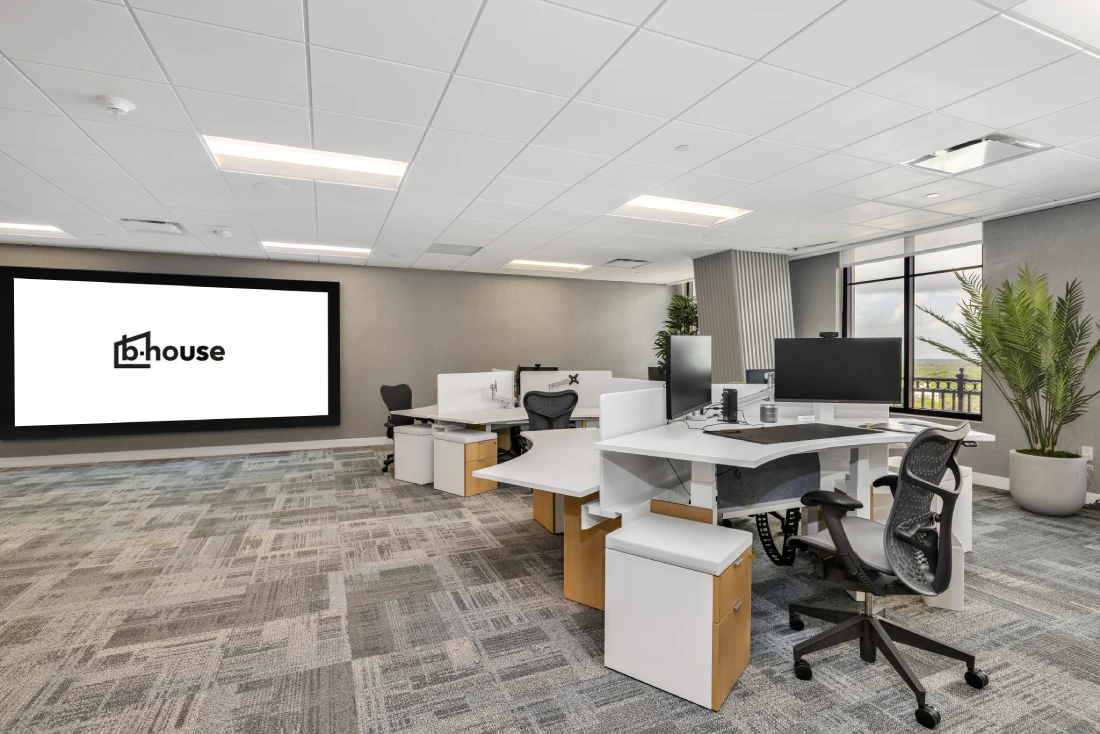
Benching systems eliminate panels in favor of shared worksurfaces supported by a common frame, with individual workstations defined by surface-mounted screens, power modules, or minimal dividers rather than full-height panels. This typology has become the dominant choice for open, collaborative floor plans over the past decade. Worksurfaces and frame components reconnect along a shared structural spine, and adding or removing positions is typically faster than with panel systems because there's less to disassemble. Benching is best for open-plan, collaboration-forward environments where acoustic privacy is a secondary priority to flexibility and density, though it comes with lower acoustic and visual privacy than panel systems and is less suited to environments with frequent confidential conversations at the individual workstation level.
Freestanding Modular
Freestanding modular furniture consists of individual desks, storage units, and screens that are not physically connected to a shared frame or panel structure, but are designed within a consistent system so they can be regrouped, paired, or redistributed independently of each other. Each piece moves independently, with no disconnection required, just repositioning, making this the fastest reconfiguration typology of the three. It's best suited to highly variable occupancy environments, hot-desk floors, and organizations that reconfigure frequently, monthly or more, rather than periodically. The trade-off is less structural cable management integration than panel or benching systems, typically requiring a complementary power distribution solution such as floor boxes or power poles, since the furniture itself doesn't carry the wiring infrastructure.
.webp)
What to Look for in Joints and Connectors
The connection hardware is where genuine modularity is won or lost. A system that looks reconfigurable in a showroom can fail in practice if the connectors degrade after a few cycles of disassembly and reassembly. Before specifying any modular system, inspect or request documentation on the following points.
- Tool-free or minimal-tool connection: the best systems use cam-lock, snap-fit, or quarter-turn connectors that don't require a screwdriver or allen key for routine reconfiguration, since systems requiring full hardware disassembly for every change add significant labor cost to each reconfiguration event.
- Connector material and tolerance: metal-on-metal connectors with machined tolerances hold up to repeated use far better than plastic clip connectors, which can develop play or fail after repeated cycles; ask the manufacturer how many reconfiguration cycles the connector is rated for.
- Cable pass-through design at connection points: reconfiguration is far more practical when cable runs don't need to be fully rerouted every time a panel or worksurface moves, and integrated cable channels should remain functional across multiple configurations, not just the original installed layout.
- Compatibility across product generations: manufacturers periodically update product lines, so confirm whether components purchased today will remain compatible with components you might purchase in three to five years, or whether a generational change would force a full system replacement instead of an incremental addition.
- Self-aligning vs. precision-dependent connectors: self-aligning connectors compensate for minor installation variance and are more forgiving for facilities teams performing reconfigurations without specialized training, while precision-dependent connectors may require more careful handling to avoid misalignment.
How Reconfigurability Affects Total Cost of Ownership Over 5–10 Years
The upfront price difference between genuinely modular and fixed furniture is real; modular systems typically cost 15 to 30 percent more per workstation at initial purchase. The total cost of ownership calculation only favors modular furniture when reconfiguration actually happens, and happens more than once.
| Scenario | Fixed Furniture Cost Over 7 Years | Modular Furniture Cost Over 7 Years |
|---|---|---|
| No reconfiguration needed | Lower, initial purchase only | Higher, premium not recovered |
| One reconfiguration event | Comparable, replacement or major retrofit | Lower, reuse existing components |
| Two or more reconfiguration events | Significantly higher, repeated replacement | Substantially lower, incremental component changes only |
| Headcount growth of 20%+ | New furniture purchase required | Add components to existing system |
| Relocation to new space | Most furniture not transferable | System typically transfers and reconfigures |
The practical rule: if your organization expects stable headcount, a single static layout, and no relocation within the furniture's useful life, fixed furniture is the lower-cost choice. If you expect headcount growth, periodic reorganization, or potential relocation within 5 to 10 years, which describes most growing or hybrid-first companies, modular furniture's reconfiguration savings typically outweigh the upfront premium by the second reconfiguration event.
How B.House Helps Clients Plan for Future Reconfigurations at Specification
The mistake most organizations make is specifying modular furniture for the layout they need today, without planning for the layout they'll likely need in two to three years. B.House addresses this at the specification stage by reviewing growth projections, anticipated work-mode shifts such as hybrid ratio changes and team restructuring, and lease term alongside the furniture selection, ensuring the system, connector type, and power infrastructure chosen today can actually support the reconfiguration your organization will need later, not just the one you're planning for now.
For brand-level comparison of the leading modular systems available in Florida, Humanscale, Haworth, Knoll, and HON, see our companion guide, Best Modular Office Furniture Systems for Corporate Teams in Florida, published in May. That article compares brands directly; this one focuses on the underlying mechanics of reconfiguration itself, independent of brand.
B.House helps organizations specify modular furniture systems built for the reconfigurations they'll actually need, not just the layout they need today. Request a modular furniture consultation at bhouse.design
FAQ: Modular Office Furniture Reconfiguration
- How do I know if a furniture system is genuinely modular or just marketed that way?
-
Ask the dealer or manufacturer to demonstrate or document the disconnection and reconnection process for a typical layout change. If the answer involves significant tool use, hardware replacement, or professional installer involvement for routine changes, the system is closer to fixed furniture with adjustable features than genuine modularity.
- How often do most organizations actually reconfigure their modular furniture?
-
Most corporate environments reconfigure modular systems every two to four years, typically driven by headcount changes, team restructuring, or shifts in hybrid work ratios. Organizations in high-growth phases may reconfigure annually; stable organizations may go five or more years between major reconfiguration events.
- Does modular furniture cost more to maintain than fixed furniture?
-
Ongoing maintenance costs are generally comparable. The cost difference shows up specifically at reconfiguration events, where modular systems are reconfigured using existing components at a fraction of the cost of purchasing and installing new fixed furniture for the same layout change.