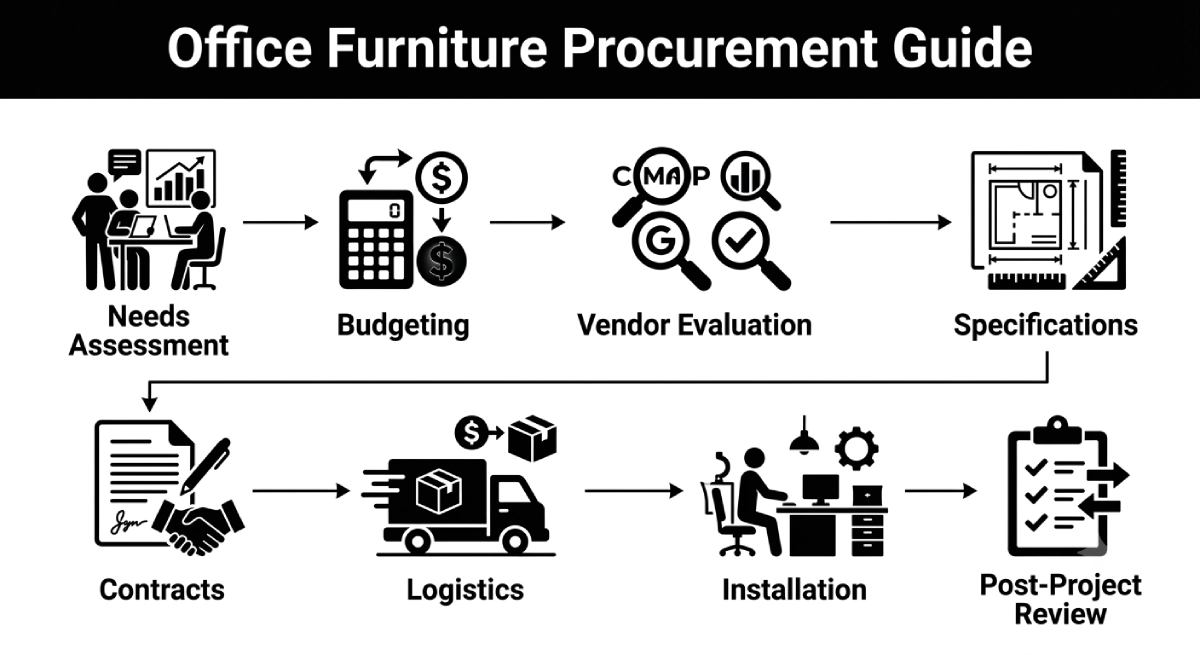
Procuring office furniture for a corporate environment is a materially complex undertaking. For Procurement Managers, Facility Managers, and Operations Directors responsible for workplace projects, furniture procurement spans multiple disciplines: needs assessment, budgeting, vendor evaluation, specification development, contract negotiation, logistics coordination, and post-project evaluation. Each phase carries distinct risk, and missteps in any phase can cascade into delays, cost overruns, and installations that fail to meet organizational requirements.
This guide provides a structured framework for the complete office furniture procurement process, designed specifically for corporate buyers managing projects for organizations with 50 to 300 employees. It covers how to select vendors, control procurement costs, reduce delivery and installation risk, and evaluate project outcomes, with a focus on purchasing decisions and vendor management rather than furniture design or workplace planning.
Phase 1: Needs Assessment, Defining What You Are Actually Buying
Furniture procurement failures frequently begin before a single vendor is contacted, in an insufficiently rigorous needs assessment. Procurement Managers who begin vendor outreach without clearly defined requirements invite substitution disputes, change orders, and product mismatches that are expensive to resolve after delivery.
Scope Definition
The first step in needs assessment is defining the full scope of the procurement. Scope definition includes:
- Furniture typologies required: workstations, seating, conference room furniture, storage, lounge furniture, reception, and any specialty items.
- Approximate quantities per typology: based on headcount, space programming, and occupancy targets.
- Performance standards: commercial-grade durability requirements, warranty minimums, and any applicable standards such as BIFMA compliance.
- Technical requirements: power integration, cable management, ergonomic adjustability standards, and technology compatibility.
- Brand and aesthetic parameters: if the organization has established design standards, these constrain the vendor pool.
Stakeholder Alignment Before Procurement Begins
One of the most common and costly mistakes in corporate furniture procurement is beginning vendor outreach before internal stakeholders, Facilities, HR, IT, and senior leadership, have aligned on requirements. Misaligned expectations surface as late-stage specification changes, which are exponentially more expensive once purchase orders are placed and lead times are running.
A structured stakeholder review of requirements documentation before RFP issuance is not bureaucratic overhead; it is risk management.
Phase 2: Budgeting, Total Cost of Ownership, Not Just Product Price
Corporate furniture budgets are systematically underestimated because decision-makers focus on product unit pricing while underweighting all-in project delivery costs. A furniture budget that accurately reflects total project cost includes:
Direct Product Costs
- Furniture unit pricing for all specified products.
- Configuration premiums, custom finishes, specialized mechanisms, integrated technology components.
- Lead time premiums, expedited manufacturing or shipping if standard lead times cannot meet project schedule.
Project Delivery Costs
- Freight: shipping from manufacturer warehouse or dealer distribution center to site; varies significantly by volume, distance, and whether white-glove delivery is required.
- Installation labor: professional installation and assembly; typically 10 to 15 percent of product cost for standard workstation projects.
- Project management fees: dealer or third-party project management; typically 5 to 8 percent of product cost on large projects.
- Debris removal: responsible disposal of packaging materials after installation; frequently overlooked and can be significant on large projects.
Contingency and Risk Budget
A realistic contingency of 10 to 15 percent of total project cost must be included in any responsible furniture procurement budget. Contingency covers product damage requiring replacement, specification changes after order placement, delivery delays requiring labor rescheduling, and punch-list resolution costs.
Procurement Managers who present budgets without contingency to finance or leadership are setting up for mid-project budget amendment requests, which create friction and erode stakeholder confidence in procurement management.
| Budget Component | Typical Range as % of Product Cost | Common Oversight Risk |
|---|---|---|
| Furniture Products | 100% (baseline) | Quoting list price without negotiated discount |
| Freight and Delivery | 5 to 12% | Underestimating for large-volume or remote sites |
| Installation Labor | 10 to 15% | Excluding after-hours or phased install premiums |
| Project Management | 5 to 8% | Assuming dealer PM is included at no charge |
| Debris Removal | 1 to 3% | Frequently omitted from early budgets |
| Contingency | 10 to 15% | Most commonly excluded; most often needed |
Phase 3: Vendor Evaluation, Selecting the Right Procurement Partner
Vendor selection is one of the highest-leverage decisions in the furniture procurement process. The wrong vendor, regardless of product quality, can undermine schedule, inflate costs, and create quality failures that damage internal stakeholder confidence in the procurement function.
Types of Furniture Vendors
Corporate furniture procurement primarily involves three vendor types, each with distinct capabilities and appropriate use cases:
- Authorized dealers: companies with direct manufacturer relationships and authorization to sell specific brands. Authorized dealers provide access to full manufacturer catalogs, accurate lead times, factory-direct warranty support, and often dedicated project management resources. For most corporate procurement projects, an authorized dealer is the preferred primary vendor.
- Multi-line dealers: dealers representing multiple manufacturers without exclusive authorization. Provide broader product access but may lack the deep product knowledge and manufacturer support of authorized dealers.
- Contract furniture manufacturers: for very large projects, direct purchasing from the manufacturer is possible in some cases. Typically requires higher volume minimums and more internal project management capacity from the buyer.
Vendor Evaluation Criteria
A structured vendor evaluation should assess:
- Manufacturer authorizations: which brands the vendor is authorized to sell, and whether those brands align with your specifications.
- Project management capability: dedicated project manager assignment, tools for order tracking, and documented processes for logistics and installation coordination.
- Installation resources: whether the vendor uses factory-trained installers or subcontracts installation, and the quality controls applied to installation crews.
- Reference projects: documented examples of similar-scope projects successfully delivered in comparable environments.
- Financial stability: for large projects, basic financial qualification of the vendor is appropriate; a vendor that cannot execute the project is a significant risk.
- Geographic reach: for multi-location projects, the vendor must have logistics and installation capability across all project sites.
BHouse Solution: Vendor Selection Support
BHouse is an authorized commercial furniture dealer serving corporate clients across Florida. Our team provides Procurement Managers with structured vendor evaluation support, helping organizations assess dealer capabilities, validate manufacturer authorizations, and select procurement partners who can execute complex furniture projects from specification through post-installation punch-list resolution.
Phase 4: Specification Development, The Foundation of a Clean Procurement
Specification development is the technical core of the furniture procurement process. Well-developed specifications protect the buyer by eliminating ambiguity in vendor quotations, enabling apples-to-apples price comparison, and providing the contractual basis for delivery and installation quality verification.
What a Complete Specification Package Contains
- Product specifications: manufacturer name, exact model number, finish code, configuration options, and any custom specifications for every line item.
- Quantity schedule: exact quantities per item, organized by zone, floor, or building as appropriate for the project scope.
- Installation drawings: furniture layout plans showing placement, orientation, and dimensional relationships for all furniture items.
- Technical standards documentation: BIFMA compliance confirmation, weight capacity certifications, sustainability certifications (GREENGUARD, level), and ergonomic standard compliance as required.
- Lead time requirements: maximum acceptable lead time for each product category; triggers for alternative specification if lead times cannot be met.
Managing Specification Alternatives and Substitutions
Vendors will occasionally propose alternatives or substitutions, particularly for products with extended lead times or supply chain constraints. Procurement Managers must establish a clear substitution approval protocol in the RFP or contract: all substitutions require written approval from the buyer before they are included in the final order. Undisclosed substitutions discovered at installation are a leading cause of dispute and remediation cost.
Phase 5: Contract Negotiation, Protecting the Buyer
Furniture procurement contracts establish the legal and operational framework for the entire project. Procurement Managers should ensure contracts address:
Pricing and Payment Terms
- Unit pricing fixed for the contract duration with clear conditions under which price adjustments are permitted.
- Payment milestones tied to project execution events, not calendar dates, to retain leverage through delivery and installation.
- Discount structure documentation: published list price discounts should be clearly documented to enable competitive comparison across vendors.
Lead Times and Delivery Commitments
- Confirmed lead times for all specified products at time of order placement.
- Remedies for lead time failures: the contract should specify what happens if products are not delivered by the required date.
- Substitution approval process: written process requiring buyer approval for any product substitution.
Warranty and Damage Claims
- Manufacturer warranty terms by product category, clearly documented.
- Dealer warranty for installation workmanship: minimum 1 year for all installation work.
- Damage claim process: timeline requirements for reporting damage, replacement lead times, and responsibility for replacement freight costs.
BHouse Solution: Procurement Coordination
BHouse provides end-to-end procurement coordination for corporate furniture projects across Florida, managing order placement, lead time tracking, vendor communication, and delivery logistics. Our project managers maintain active order visibility from purchase order through site delivery, proactively resolving supply chain issues before they affect project schedules.
Phase 6: Logistics Coordination, Getting Furniture to Site Without Disruption
Logistics coordination is a specialized project management discipline that determines whether well-specified, well-procured furniture actually arrives on schedule, in sequence, and without damage.
Pre-Delivery Site Coordination
Before any furniture delivery is scheduled, Procurement Managers must confirm:
- Site readiness: construction, flooring, and infrastructure work complete in areas designated for delivery.
- Building access confirmed: freight elevator reservations, loading dock access windows, and security clearance for delivery crews.
- Staging area identified and protected: clear area within the building for receiving and staging furniture prior to final placement.
- Delivery sequence plan: furniture delivered in installation sequence; out-of-sequence delivery blocks installation and creates costly rescheduling.
Freight and Handling Risk
Furniture shipped over long distances, particularly upholstered seating and glass components, carries meaningful damage risk. Procurement Managers should confirm:
- Products are shipped as blanket-wrapped freight, not loose-loaded, to minimize transit damage.
- Delivery crews include the labor to bring product to the floor of installation, not just to the loading dock.
- Damage inspection protocol is established before delivery begins. All deliveries should be inspected and any visible damage noted on delivery receipts before the delivery crew leaves the site.
Phase 7: Installation Planning, Managing the Field
Professional installation management ensures furniture arrives where it belongs, assembled correctly, and ready for use. Key installation planning activities include:
- Issuing installation drawings to the installation crew before work begins, not on the day of installation.
- Assigning a point-of-contact to the installation site for each day of installation to answer questions and approve minor field adjustments.
- Establishing a quality verification process: furniture placement and assembly should be verified against drawings by a designated buyer representative before the installation crew leaves each zone.
- Documenting all damage, missing components, and quality deficiencies on a formal punch list before final payment is released.
Phase 8: Post-Project Evaluation, Closing the Loop
A post-project evaluation conducted 30 to 60 days after project completion provides critical data for improving future procurement performance. Key evaluation activities include:
- Comparing actual project costs against budget, documenting variances and their causes.
- Vendor performance assessment: evaluating lead time accuracy, delivery quality, installation quality, and responsiveness to punch-list items.
- End-user satisfaction feedback: gathering input from employees on furniture performance and ergonomic experience.
- Documentation archiving: preserving specifications, drawings, contracts, warranty records, and vendor contact information for future project reference.
Organizations that complete formal post-project evaluations consistently outperform those that do not in subsequent procurement cycles, because they build institutional knowledge rather than repeating mistakes.
| Procurement Phase | Key Risk | Risk Mitigation Strategy |
|---|---|---|
| Needs Assessment | Under-defined requirements leading to substitution disputes | Stakeholder sign-off on requirements before RFP |
| Budgeting | Missing delivery and contingency costs | Build total cost model including all delivery components |
| Vendor Evaluation | Selecting vendor on price without capability assessment | Structured evaluation with reference checks |
| Specification | Ambiguous specs enabling unauthorized substitutions | Model number-level specifications with substitution approval protocol |
| Contract | No remedies for lead time failures or damage | Lead time commitments and damage claim process in contract |
| Logistics | Out-of-sequence delivery blocking installation | Delivery sequence plan developed with project manager |
| Installation | Quality deficiencies discovered after final payment | Formal punch list before final payment release |
| Post-Project | Institutional knowledge lost | Documented evaluation and archived project records |
Frequently Asked Questions
How should Procurement Managers evaluate furniture vendor pricing to ensure they are receiving competitive rates?
Commercial furniture is almost universally sold at a discount from published list price. Procurement Managers should request that vendors quote the list price and the applied discount percentage separately for each line item, rather than net price only. This enables comparison of the effective discount rate across vendors, not just the bottom line number, and surfaces situations where vendors are substituting lower-specification products to appear price-competitive.
What BIFMA certifications should we require for corporate furniture procurement?
BIFMA publishes performance standards for commercial office furniture. For corporate procurement, the most relevant are BIFMA X5.1 for office seating, X5.5 for desk products, and X5.9 for storage. Requiring BIFMA compliance in specifications ensures products meet tested commercial-grade performance and durability standards, which is particularly important for high-usage environments like hot desking areas.
What is the typical payment structure for a corporate furniture procurement project?
Most commercial furniture procurement follows a milestone-based payment structure. A common structure is 50 percent deposit on order placement, 40 percent on delivery, and 10 percent retained until punch-list items are resolved. Procurement Managers should avoid structures that release 100 percent of payment on delivery; the retained 10 percent is the primary leverage for ensuring timely punch-list resolution.
How long should we budget for lead times on commercial office furniture?
Lead times for commercial-grade office furniture typically range from 6 to 14 weeks depending on the product category and manufacturer. Height-adjustable desks and high-specification ergonomic seating often run 10 to 14 weeks. Commodity seating and storage products may be available in 6 to 8 weeks. Procurement timelines must account for these lead times; projects that begin procurement planning 4 weeks before the target installation date are almost certain to miss their schedule.
What should we include in a request for proposal (RFP) for a furniture procurement project?
A corporate furniture RFP should include: the complete furniture specification package with quantities, a project timeline with key milestones, site information for delivery and installation, payment terms, warranty and damage claim requirements, substitution approval requirements, references from comparable projects, and insurance requirements for installation crews. RFPs that omit site logistics, payment terms, or substitution protocols frequently generate non-comparable vendor responses that are difficult to evaluate.
How do we manage a furniture procurement project across multiple office locations?
Multi-site procurement requires a vendor with logistics and installation capability across all sites, or a primary vendor who can coordinate subcontractors in remote markets. Procurement Managers should evaluate each vendor's specific presence and capabilities in each project location, not assume that regional or national coverage implies equal service quality everywhere. A single-source contract across all locations simplifies procurement management but requires rigorous vendor qualification at each site.
Partner with BHouse for Your Office Furniture Procurement Project
BHouse provides procurement advisory services for corporate furniture projects across Florida, from vendor selection and specification development through contract coordination, delivery logistics, and installation management.Contact BHouse today to discuss your furniture procurement project and download our Office Furniture Procurement Checklist, a structured tool for managing every phase of corporate furniture procurement from needs assessment through post-project evaluation.
Visit www.bhouse.com or call our Miami office to get started.


.webp)



.webp)